The Great Firewall Fortress
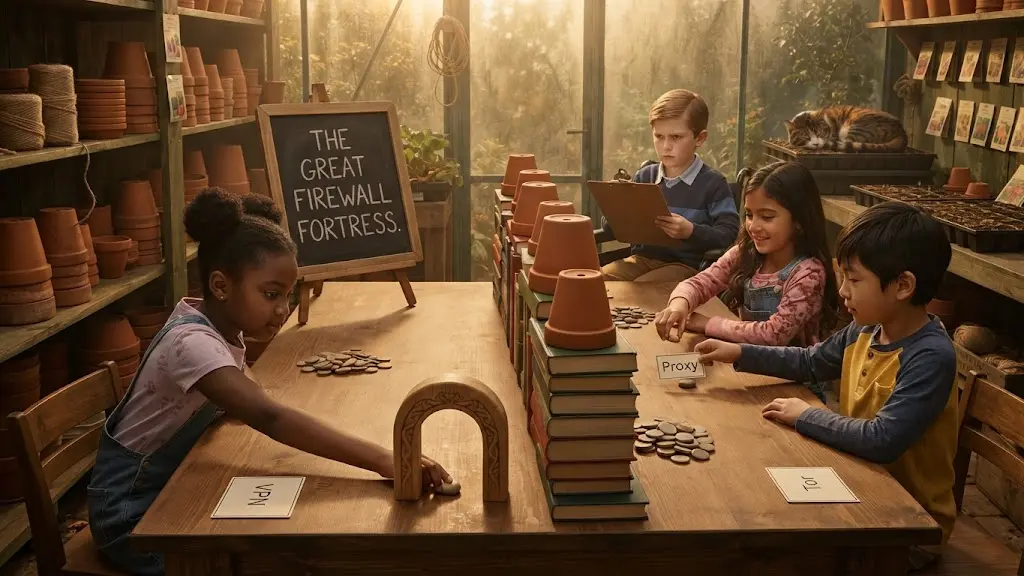
Build a wall of books down the middle of a table. One player is the Censor, who controls everything that crosses the wall. The other players are trying to move their tokens from one side to the other, representing messages they want to send to a friend.
Three tools are available.
The VPN card lets you move your token under the table in a literal tunnel, bypassing the wall entirely.
The Proxy card lets you ask another player to carry your token across on your behalf.
The Tor card lets you bounce your token to two different players before it reaches the goal, making the path so complicated that even the Censor loses track of where it came from.
Each tool has a different feel, and the Censor has to try a different strategy to block each one. What makes the game interesting is watching the Censor’s frustration grow as tokens keep arriving at the goal by unexpected routes.
Each card maps onto a real tool that people use for exactly the same purpose. The VPN card represents a real VPN. The Proxy card represents a proxy server. The Tor card represents the Tor network, which routes your traffic through multiple computers around the world before it arrives at its destination. Understanding why Tor is harder to track than a simple VPN becomes intuitive once you have watched a token bounce through three pairs of hands.
Try a second round where the Censor announces which tool they are watching for, and see how the other players adapt.
The rules
Everyone starts with three tokens and is trying to get them across. A turn is one crossing attempt by every player at once.
Each player picks a route and places the card for it face-down: direct, VPN, proxy or Tor. Direct is always available. The other three are used once each per game.
The Censor names one route out loud, and only one: the route being watched this turn.
Everyone turns their card over.
A token on a named route is turned back and tried again another turn. A token on any other route is through.
Tor is the exception. It takes two turns to arrive, and the Censor has to name Tor on both of those turns to stop it. Naming it once is not enough, because the path has more than one hop in it.
The game ends when everyone is out of tokens or out of turns. Count what got through. Then somebody else takes the Censor’s chair and it runs again.
There is no safe route and no route worth always picking. Going direct every turn is free and gets nothing through against a Censor who has noticed. Going Tor every turn is slow enough that a Censor who simply keeps saying Tor stops all of it.
What you need
A barrier that blocks sight of the far side and can be reached under. A row of standing books does both. A line drawn on the table does neither.
A token for each player, and three cards marked VPN, Proxy and Tor.
The Censor has to be unable to see the crossing, not merely disapprove of it.
Last reviewed: 2026-07-08.