Encryption Escape Room
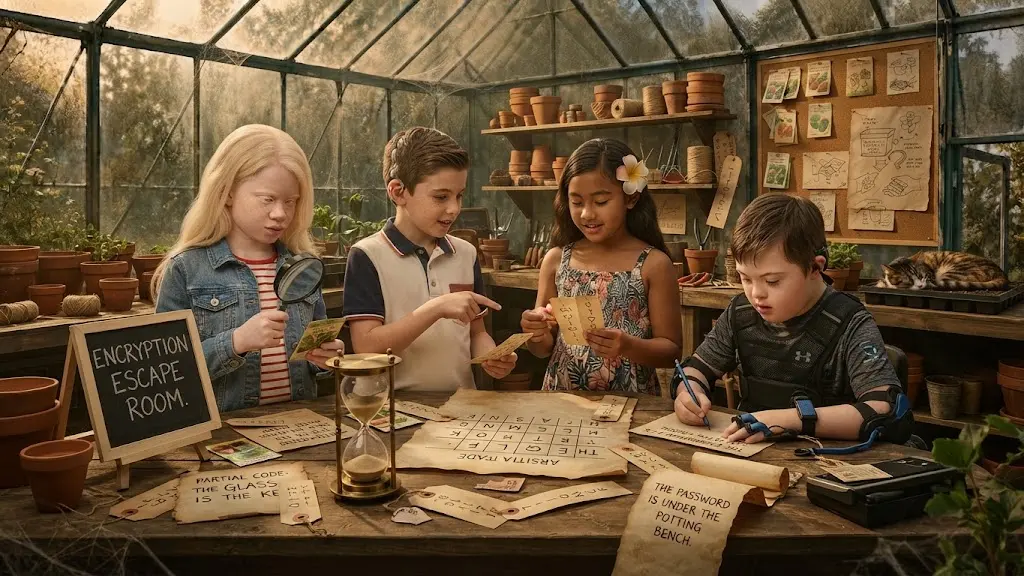
Three coded messages go on the table at once, each using a simple substitution cipher where a letter is replaced by another letter or by a number. Every sheet carries its own method, so any of them can be started at any time and none of them waits on another. Each one decodes to a piece of the same instruction. The team wins by working out what that instruction says before the clock runs out.
Two of the three are enough. Laid out side by side rather than in a line, a sheet nobody cracks costs the team one fragment instead of the rest of the game.
The pleasure of cracking a cipher under time pressure is its own reward, and it does not require any technical knowledge to enjoy. But the game also produces something else, quietly. You held a message that was opaque: a sequence of symbols that meant nothing. You found the key and applied it, and the message became legible. Encryption is exactly that transformation. It is not a property that data simply has; it is a process that you apply, and the key is what makes the difference between a locked message and an open one.
Good escape rooms scale with the ambition of the puzzles. Adding pattern-recognition challenges, multi-step decryptions, or deliberate red herrings makes them considerably harder. The time limit can be adjusted freely. For an extra layer, one player can take the role of Interceptor, trying to crack the same puzzles simultaneously and racing the team to the final message.
The game works particularly well as a group activity because the puzzles benefit from different people noticing different things. Someone will spot a pattern that everyone else walked past, and that moment of “wait, look at this” is one of the best things a game can produce.
What you need
Paper for the sheets, and a clock everyone can see.
The three sheets
Each carries its own method. There is no order to them.
Sheet |
On the paper |
Method given on the sheet |
Decodes to |
|---|---|---|---|
A |
|
every letter has moved three places |
THE PASSWORD IS |
B |
|
every letter has moved five places |
UNDER THE POTTING |
C |
|
A is 1 |
BENCH |
Any two of the three give something a team can act on. A and B give the password is under the potting, B and C give under the potting bench, A and C give the password is, something, bench. All three give the sentence whole.
Chaining them the other way, where each solution unlocks the next, sounds tidier and plays far worse. Three puzzles solved four times in five finish as a chain about half the time, and as a set of three about nine times in ten. The sheets nobody reaches in a chain are the ones somebody wrote.
Nobody has to sit the game out preparing it. The sheets above can be copied once by anyone, including somebody who then plays, because the answers are on this page rather than in one player’s head.
Related
Last reviewed: 2026-07-08.